Quantum Physics
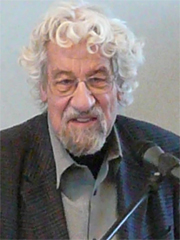
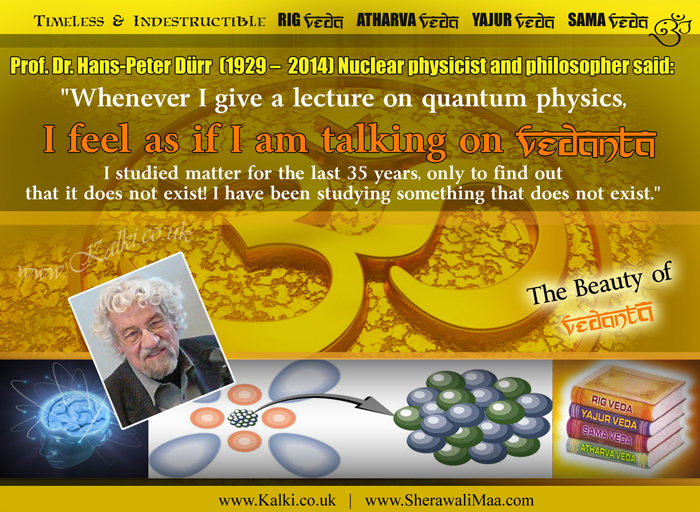
Hans-Peter Dürr (1929–2014) said: "Whenever I give a lecture on quantum physics, I feel as if I am talking on Vedanta. I studied matter for the last 35 years, only to find out that it does not exist! I have been studying something that does not exist."
[Hans-Peter Dürr, ein renommierter Quantenphysiker, vertrat die Ansicht, dass „Materie“ im klassischen Sinne nicht existiert. Basierend auf der Quantenphysik postulierte er, dass die Wirklichkeit nicht dinglich, sondern eher eine Potenzialität oder Verbundenheit ist. Diese Anschauung zeigt Parallelen zur vedantischen Philosophie, in der die materielle Welt als Maya (Illusion) betrachtet wird.]
Famously noted the similarity between quantum physics and Vedanta. He argued that modern physics reveals "matter" as a, not fundamental, but instead an interaction-based, non-material phenomenon, paralleling the Vedantic concept of Maya (illusion).
Key Aspects of Dürr’s Observation:
Matter as Illusion: Dürr suggested that what we perceive as solid matter is, at its base, not material at all, but rather "something that does not exist" in the conventional sense.
Interaction-Driven: He noted that particles disappear as persistent matter, existing only as interactions or potentiality.
Connection to Vedanta: His work echoed the Advaita Vedanta philosophy, which asserts that the material world of names and forms (Maya) is a superficial reality obscuring a deeper, unified non-dual reality.
The "Vedanta" Connection: He saw a profound parallel between the quantum field—where particles are emergent patterns—and the Vedantic concept of Brahman (the ultimate reality) and Maya (the illusion of the material world).
Consciousness Focus: Dürr, like other quantum physicists, sometimes suggested a conscious "matrix" lies behind the physical world.
Dürr's perspective aligns with the idea that quantum field theory reveals underlying fields rather than discrete "solid" particles, making "matter" an emergent phenomenon rather than a primary substance.
Literary Source: Many of these themes are detailed in his final book, titled Matter Does Not Exist! (original German: Materie gibt esnicht!), which explores how modern physics necessitates a new philosophical worldview.
Key Themes of "Matter Does Not Exist!"
Matter is not Made of Matter: Dürr famously argued that at the quantum level, the universe is not composed of separate particles, but rather of interconnected processes and energy fields.
"Es gibt keine Materie!" (2012): This phrase is the title of his 2012 book (Matter Does Not Exist! Revolutionary Thoughts about Physics and Mysticism), which posits that reality is defined by "Gestalt" (structure/form) rather than substance.
A-duality/Non-Duality: Dürr believed that modern physics supports a non-dual view of reality, similar to the Advaita Vedanta philosophy, where the world is not split into subject and object, but is one interconnected whole.
Potentiality vs. Reality: He stated that quantum mechanics shows the world is, at its foundation, potentiality (an "energy sea") rather than a solid, deterministic entity.
Web of Relationships: Dürr suggested that "things" are actually "processes" or "relational information".