• Sarve bhavantu sukhinah
    Sarve santu nira-maya-ah
    Sarve bhadrani pashyantu ma-kaschit dukha-bhak bhavet

    - Brihadaranyaka Upanishad: 1.4.14

  • “May all of mankind be happy May all be healthy
    May all experience prosperity
    May none (in the world) suffer.”

    - Brihadaranyaka Upanishad: 1.4.14

  • Asato Maa Sad Gamaya Tamaso Maa
    Jyotir Gamaya Mrityor Maa Amritam Gamaya

    - Brihadaranyaka Upanishad: 1.3.28

  • “O' Lord, please lead me from darkness of ignorance
    to the light (of knowledge) From death (limitation)
    to immortality (liberation).”

    - Brihadaranyaka Upanishad: 1.3.28


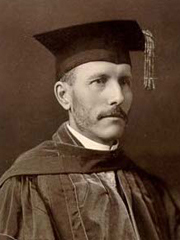
Florian Cajori (1859-1930)

Swiss-American Historian of Mathematics.

Florian Cajori 1859 – 1930 Immigrated to the United States at the age of sixteen. He received both his bachelor's and master's degrees from the University of Wisconsin–Madison.

 He taught for a few years at Tulane University, before being appointed as professor of applied mathematics there in 1887. He was then driven north by tuberculosis. He founded the Colorado College Scientific Society and taught at Colorado College where he held, at different times, the chair in physics, the chair in mathematics, and the position Dean of the engineering department. While in Colorado, he received his doctorate from Tulane in 1894. 

Cajori's A History of Mathematics (1894) was the first popular presentation of the history of mathematics in the United States. Based upon his reputation in the history of mathematics (even today his 1928–1929 History of Mathematical Notations has been described as "unsurpassed") he was appointed in 1918 to the first history of mathematics chair in the U.S, created especially for him, at the University of California, Berkeley. He remained in Berkeley, California until his death in 1930.

 Cajori did no original mathematical research unrelated to the history of mathematics. In addition to his numerous books, he also contributed highly recognized and popular historical articles to the American Mathematical Monthly. His last work was a revision of Andrew Motte's 1729 translation of Newton's Principia, vol.1 The Motion of Bodies, but he died before it was completed. The work was finished by R.T.Crawford of Berkeley, California. 

Societies and honors  

•(1917–1918) Mathematical Association of America president 

•(1923) American Association for the Advancement of Science vice-president 

•(1924–1925) History of Science Society vice-president 

•(1929–1930) Comité International d'Histoire des Sciences vice-president 

•The Cajori crater on the Moon was named in his honour 

Publications  

•1890: The Teaching and History of Mathematics in the United States U.S. Government Printing Office. 

•1893: A History ofMathematics, Macmillan & Company. 

•1898: A History of Elementary Mathematics, Macmillan. 

•1909: A History of the Logarithmic Slide Rule and Allied Instruments The Engineering News Publishing Company. 

•1916: William Oughtred: a Great Seventeenth-century Teacher of Mathematics The Open Court Publishing Company 

•1917: A History of Physics in its Elementary Branches: Including the Evolution of Physical Laboratories, The Macmillan Company. 

•1919: A History of the Conceptions of Limits and Fluxions in Great Britain, from Newton to Woodhouse, Open Court Publishing Company. 

•1920: On the History of Gunter's Scale and the Slide Rule during the Seventeenth Century Vol. 1, University of California Press. 

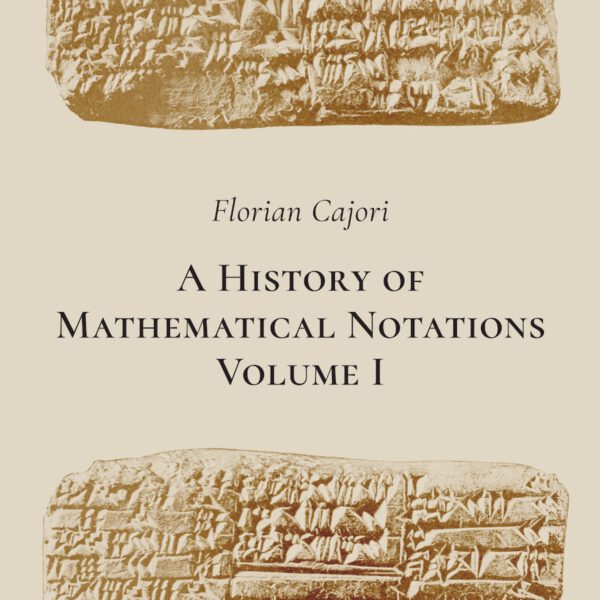
•1928: A History of Mathematical Notations The Open Court Company. 

•1934: Sir Isaac Newton's Mathematical Principles of Natural Philosophy and His System of the World tr. Andrew Motte, rev. Florian Cajori. Berkeley: University of California Press. 

Articles  

•1913: "History of the Exponential and Logarithmic Concepts", American Mathematical Monthly 20: 

•Page 5 From Napier to Leibniz and John Bernoulli I, 1614 — 1712 

•Page 35 The Modern Exponential Notation (continued) 

•Page 75 : The Creation of a Theory of Logarithms of Complex Numbers by Euler, 1747 — 1749 

•Page 107 : From Euler to Wessel and Argand, 1749 — 1800, Barren discussion. 

•Page 148: Generalizations and refinements effected during the nineteenth century : Graphic representation 

•Page 173: Generalizations and refinements effected during the nineteenth century  

•Page 205: Generalizations and refinements effected during the nineteenth century. These seven installments of the article are available through the Early Content program of Jstor. 

•1923: "The History of Notations of the Calculus." Annals of Mathematics, 2nd Ser., Vol. 25, No. 1, pp. 1–46

Legacy: Cajori passed away in 1930, having established himself as one of the most significant and quoted historians of mathematics

Online Books By: Florian Cajori   https://onlinebooks.library.upenn.edu/

Hindus: Inventors of Algebra

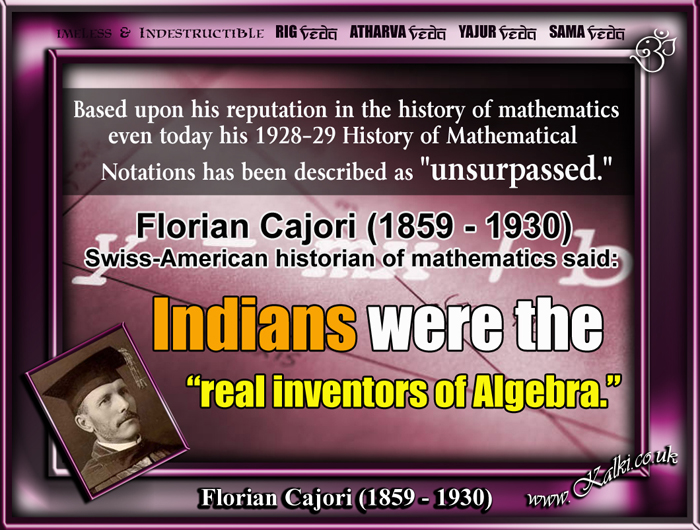
Florian Cajori, Swiss-American historian of mathematics said: 


“The learned Brahmins of Hindostan are the real inventors ofalgebra”

Based upon his reputation in the history of mathematics even today his 1928–29 History of Mathematical Notations has been described as "unsurpassed." 

Full extract:

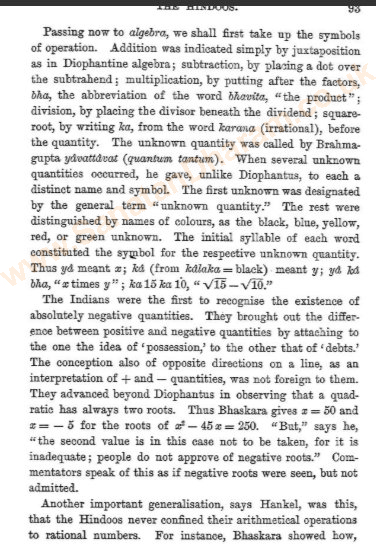
"Another important generalisation, says Hankel, was this, that the Hindoos never confined their arithmetical operations to rational numbers. For instance, Bhaskara showed how, the square root of the sum of rational and irrational numbers could be found. The Hindoos never discerned the dividing line between numbers andmagnitudes, set up by the Greeks, which, though the product of a scientific spirit, greatly retarded the progress of mathematics. They passed from magnitudes to numbers and from numbers to magnitudes without anticipating that gap which to a sharply discriminating mind exists between the continuous and discontinuous. Yet by doing so the Indians greatly aided the general progress of. mathematics. Indeed, if one understands by algebra the application of arithmetical operations to complex magnitudes of all sorts, whether rational or irrational numbers orspace magnitudes, then the learned Brahmins of Hindostan are the real inventors of algebra.” ^

In this connection Aryabhatta speaks of dividing a number into periods of two and threedigits. Brom this we infer that the principle of position and the zero in the numeral notation were already known to him. In figuring with zeros, a statement of Bhaskara is interesting. A fraction whose denominator is zero, says he, admit^£,uq^ alteration, though much be added or subtracted. Indeed, in the same way, no change tal&s place in'" the Infinite and immutable Deity when worlds are destroyed or created, even though numewis orders of beings be taken up or brought forth. Though in this he apparently evinces clear mathematical notions, yet in other places he ^akes a complete failure in figuring with fractions of zero denominator." - Page 93/94

Book Source: A History Of Mathematics  by: Florian Cajori. Publication date: 1894

Available on: Amazon

Available online: Archive.org

Original slides were created in:  26-03-2019 & Uploaded on AMC


MANUSCRIPT (MS Syriac [Paris], No. 346):

Florian Cajori, Swiss-American historian of mathematics said: 

THAT our common numerals are of Hindu origin seems to be a well-established fact, and that Europe received them from the Arabs seems equally certain. 

Source: http://www.syriacstudies.com

Syrian scholar and Bishop Severus Sebokht (575 - 667) said: 

"I will omit all discussion of the science of the Hindus, a people not the same as the Syrians; 

their subtle discoveries in this science of astronomy, discoveries that are more ingenious than those 

of the Greeks and the Babylonians; their valuable methods of calculation; and their computing that surpasses description. 

I wish only to say that this computation is done by means of nine signs. If those who believe, 

because they speak Greek, that they have reached the limits of science should know these things they

 would be convinced that there are also others who know something." 

Full Extract:

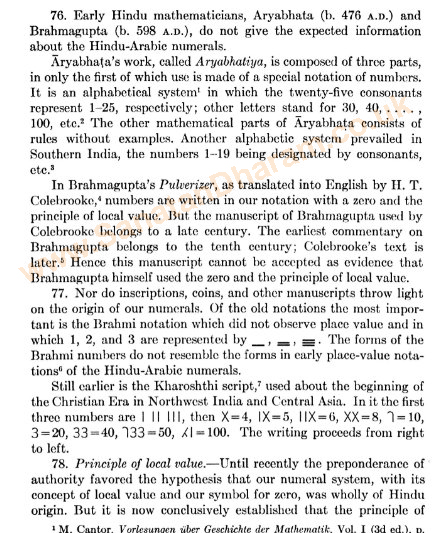
"In Brahmagupta's Pulverizer, as translated into English by H. T. Colebrooke,4 numbers are written in our notation with a zero and the principle of local value. But the manuscript of Brahmagupta used by Colebrooke belongs to a late century. The earliest commentary on Brahmagupta belongs to the tenth century; Colebrooke's text is later.5 Hence this manuscript cannot be accepted as evidence that Brahmagupta himself used the zero and the principle of local value.

77. Nor do inscriptions, coins, and other manuscripts throw light on the origin of our numerals. Of the old notations the most important is the Brahmi notation which did not observe place value and in

which 1, 2, and 3 are represented by , , = . The forms of the Brahmi numbers do not resemble the forms in early place-value notations6 of the Hindu-Arabic numerals.

Still earlier is the Kharoshthi script,7 used about the beginning of the Christian Era in Northwest India and Central Asia. In it the first three numbers are I II III, then X = 4, IX = 5, IIX = 6, XX = 8, 1 = 10, 3 = 20, 33=40, 133 = 50, XI =100. The writing proceeds from right to left.

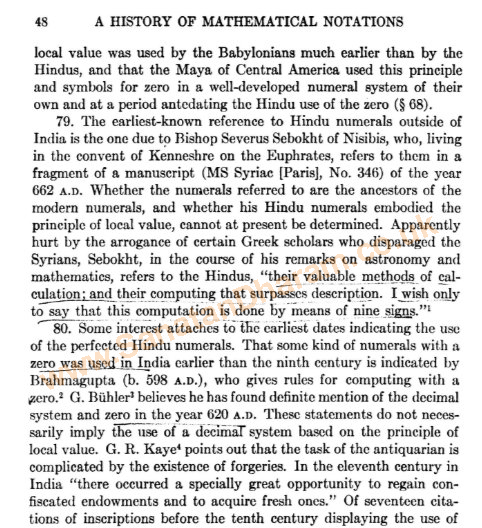
78. Principle of local value. — Until recently the preponderance of authority favored the hypothesis that our numeral system, with its concept of local value and our symbol for zero, was wholly of Hindu origin. But it is now conclusively established that the principle oflocal value was used by the Babylonians much earlier than by the Hindus, and that the Maya of Central America used this principle and symbols for zero in a well-developed numeral system of their own and at a period antedating the Hindu use of the zero (§ 68).

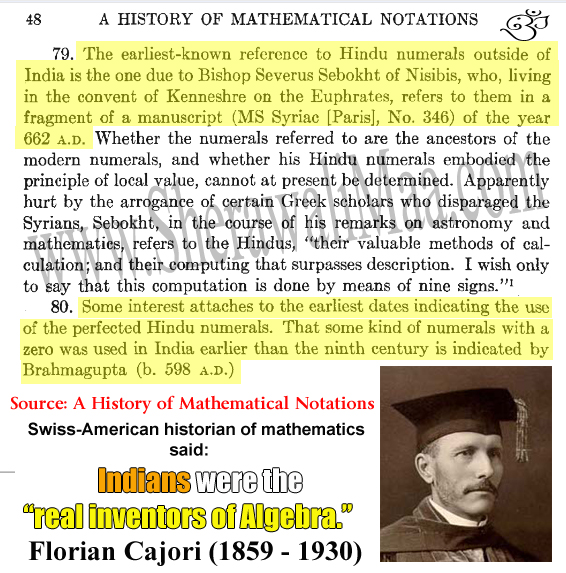
79. The earliest-known reference to Hindu numerals outside of India is the one due to Bishop Severus Sebokht ofNisibis, who, living in the convent of Kenneshre on the Euphrates, refers to them in a fragment of a manuscript (MS Syriac [Paris], No. 346) of the year 662 A.D. Whether the numerals referred to are the ancestors of the modern numerals, and whether his Hindu numerals embodied the principle of local value, cannot at present be determined. Apparently hurt by the arrogance of certain Greek scholars who disparaged the Syrians, Sebokht, in the course of his remarks on astronomy and mathematics, refers to the Hindus, " their valuable methods, of calculation ;and their computing that surpasses description. I wish only to say that this computation is done by means of ninesigns."

80. Some interest attaches to the earliest dates indicating the use of the perfected Hindu numerals. That some kind of numerals with azero use in India earlier than the ninth century is indicated by

Brahmagupta (b. 598 A.D.), who gives rules for computing with a #ero.2 G. Biihler3 believes he has found definite mention of the decimal system and zero m the year 620 A.D. These statements do not necessarily imply the use of a decimal" system based on the principle of local value. G. R. Kaye4 points out that the task of the antiquarian is complicated by the existence of forgeries. In the eleventh century in India "there occurred a specially great opportunity to regain confiscated endowments and to acquire fresh ones." Of seventeen citations of inscriptions before the tenth century displaying the use of place value in writing numbers, all but two are eliminated as forgeries; these two are for the years 813 and 867 A.D.; Kaye is not sure of the reliability even of these. According to D.JE. Smith _and JLjg.^ Karpinski,5 the earliest authentic document unmistakably containing the numerals mttMyh^^r^njMia belongs to the year 876 A.D."- Page 47/48

Book Source: A History Of Mathematical Notations Vol I  by: Florian Cajori. Publication date:1928 (Volume II in 1929)

Available on: Amazon

Available online: Archive.org

Original slides were created in:  26-03-2019 & Uploaded on AMC


Florian Cajori, Swiss-American historian of mathematics said: 


“The learned Brahmins of Hindostan are the real inventors ofalgebra”

Based upon his reputation in the history of mathematics even today his 1928–29 History of Mathematical Notations has been described as "unsurpassed." 

Full extract:

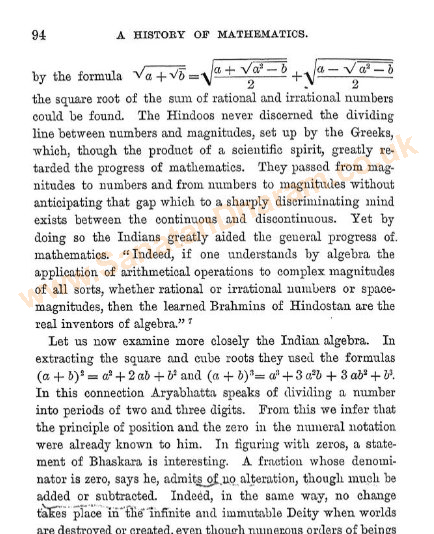
"Another important generalisation, says Hankel, was this, that the Hindoos never confined their arithmetical operations to rational numbers. For instance, Bhaskara showed how, the square root of the sum of rational and irrational numbers could be found. The Hindoos never discerned the dividing line between numbers andmagnitudes, set up by the Greeks, which, though the product of a scientific spirit, greatly retarded the progress of mathematics. They passed from magnitudes to numbers and from numbers to magnitudes without anticipating that gap which to a sharply discriminating mind exists between the continuous and discontinuous. Yet by doing so the Indians greatly aided the general progress of. mathematics. Indeed, if one understands by algebra the application of arithmetical operations to complex magnitudes of all sorts, whether rational or irrational numbers orspace magnitudes, then the learned Brahmins of Hindostan are the real inventors of algebra.” ^

In this connection Aryabhatta speaks of dividing a number into periods of two and threedigits. Brom this we infer that the principle of position and the zero in the numeral notation were already known to him. In figuring with zeros, a statement of Bhaskara is interesting. A fraction whose denominator is zero, says he, admit^£,uq^ alteration, though much be added or subtracted. Indeed, in the same way, no change tal&s place in'" the Infinite and immutable Deity when worlds are destroyed or created, even though numewis orders of beings be taken up or brought forth. Though in this he apparently evinces clear mathematical notions, yet in other places he ^akes a complete failure in figuring with fractions of zero denominator." - Page 93/94

Book Source: A History Of Mathematics  by: Florian Cajori. Publication date: 1894

Available on: Amazon

Available online: Archive.org

Florian Cajori, Swiss-American historian of mathematics said: 

THAT our common numerals are of Hindu origin seems to be a well-established fact, and that Europe received them from the Arabs seems equally certain. 

Source: http://www.syriacstudies.com

Syrian scholar and Bishop Severus Sebokht (575 - 667) said: 

"I will omit all discussion of the science of the Hindus, a people not the same as the Syrians; 

their subtle discoveries in this science of astronomy, discoveries that are more ingenious than those 

of the Greeks and the Babylonians; their valuable methods of calculation; and their computing that surpasses description. 

I wish only to say that this computation is done by means of nine signs. If those who believe, 

because they speak Greek, that they have reached the limits of science should know these things they

 would be convinced that there are also others who know something." 

FullExtract:

"In Brahmagupta's Pulverizer, as translated into English by H. T. Colebrooke,4 numbers are written in our notation with a zero and the principle of local value. But the manuscript of Brahmagupta used by Colebrooke belongs to a late century. The earliest commentary on Brahmagupta belongs to the tenth century; Colebrooke's text is later.5 Hence this manuscript cannot be accepted as evidence that Brahmagupta himself used the zero and the principle of local value.

77. Nor do inscriptions, coins, and other manuscripts throw light on the origin of our numerals. Of the old notations the most important is the Brahmi notation which did not observe place value and in

which 1, 2, and 3 are represented by , , = . The forms of the Brahmi numbers do not resemble the forms in early place-value notations6 of the Hindu-Arabic numerals.

Still earlier is the Kharoshthi script,7 used about the beginning of the Christian Era in Northwest India and Central Asia. In it the first three numbers are I II III, then X = 4, IX = 5, IIX = 6, XX = 8, 1 = 10, 3 = 20, 33=40, 133 = 50, XI =100. The writing proceeds from right to left.

78. Principle of local value. — Until recently the preponderance of authority favored the hypothesis that our numeral system, with its concept of local value and our symbol for zero, was wholly of Hindu origin. But it is now conclusively established that the principle oflocal value was used by the Babylonians much earlier than by the Hindus, and that the Maya of Central America used this principle and symbols for zero in a well-developed numeral system of their own and at a period antedating the Hindu use of the zero (§ 68).

79. The earliest-known reference to Hindu numerals outside of India is the one due to Bishop Severus Sebokht ofNisibis, who, living in the convent of Kenneshre on the Euphrates, refers to them in a fragment of a manuscript (MS Syriac [Paris], No. 346) of the year 662 A.D. Whether the numerals referred to are the ancestors of the modern numerals, and whether his Hindu numerals embodied the principle of local value, cannot at present be determined. Apparently hurt by the arrogance of certain Greek scholars who disparaged the Syrians, Sebokht, in the course of his remarks on astronomy and mathematics, refers to the Hindus, " their valuable methods, of calculation ;and their computing that surpasses description. I wish only to say that this computation is done by means of ninesigns."

80. Some interest attaches to the earliest dates indicating the use of the perfected Hindu numerals. That some kind of numerals with azero use in India earlier than the ninth century is indicated by

Brahmagupta (b. 598 A.D.), who gives rules for computing with a #ero.2 G. Biihler3 believes he has found definite mention of the decimal system and zero m the year 620 A.D. These statements do not necessarily imply the use of a decimal" system based on the principle of local value. G. R. Kaye4 points out that the task of the antiquarian is complicated by the existence of forgeries. In the eleventh century in India "there occurred a specially great opportunity to regain confiscated endowments and to acquire fresh ones." Of seventeen citations of inscriptions before the tenth century displaying the use of place value in writing numbers, all but two are eliminated as forgeries; these two are for the years 813 and 867 A.D.; Kaye is not sure of the reliability even of these. According to D.JE. Smith _and JLjg.^ Karpinski,5 the earliest authentic document unmistakably containing the numerals mttMyh^^r^njMia belongs to the year 876 A.D."- Page 47/48

Book Source: A History Of Mathematical Notations Vol I  by: Florian Cajori. Publication date:1928 (Volume II in 1929)

Available on: Amazon

Available online: Archive.org