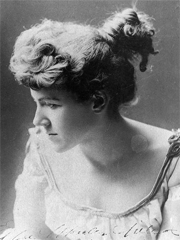
Prominent American Poet
Ella Wheeler Wilcox (1850–1919) was a prominent American author and poet, best known for her work
‘Poems ofPassion’.
Having her works published in several books, magazines, and periodicals, she can be considered one of the most popular poets of her time. Though not highly critically acclaimed, her works were widely accepted and loved by the public. Her works popularized the ideals of a philosophical movement know as New Thought, which promotes ideas of an Infinite Intelligence, of all people being divine spiritual beings, and ways to live a healthy spiritual life. Her poems thus reflected her belief that eventually good would triumph over evil. They also used to be of an optimistic nature and encouraged a positive approach to life.
Her poetry was written in plain, rhyming verse, and was highly popular among the masses. Some of her popular works were‘A Woman of the World’ published in1904, ‘Poems of Peace’, published in1906, and ‘Poems of Experience’ published in1910.
She wrote her autobiography as well, which was titled ‘The Worlds andI’, and was published just a year before her death.
Childhood & Early Life
Ella Wheeler was born on 5 November 1850 in Johnstown in Wisconsin. She was the youngest of four siblings.
Her family had to soon move to Madison, which was the capital city of Wisconsin. In the meantime, Ella had started writing poetry though she was very young.
Her works started appearing in papers and journals while she was still a teenager.
By the time she completed her high school, she had become a very well-known poet all over the state. She attended the University of Wisconsin in 1867-68 but she gave up her studies to devote herself to writing.
Style and Themes: Her poetry often tackled the complexities of life with a focus on positivity, practical spirituality, and emotional strength. She wrote about romantic passion but also moralistic themes, advising readers to accept life's challenges.
"Solitude" (1883): Written after seeing a grieving woman on a train, the poem argues that while the world welcomes joy, it abandons those who are sad, highlighting a philosophy of inner strength and self-reliance.
"Protest" (1914): A famous poem often quoted to encourage speaking out against injustice, featuring the line "To sin by silence when we should protest / Makes cowards out of men".
Popularity: She was tremendously popular in her time, acting as a "poet of the people" rather than a critical darling, offering comfort and straightforward advice.