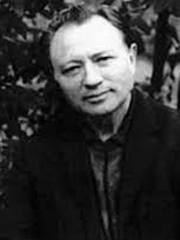
Spirkin wrote:
"The sages of India discovered astonishingly subtle and profound psycho-biophysical connections between human organism and cosmic subterranean processes. They knew much that even today is beyond the ken European scientific thought, or that it ignores, often trying to conceal its helplessness by asserting that oriental wisdom is mere mysticism, and thus showing its inability to distinguish the rational but not yet fully understandable essence from various figments of imagination…"
Spirkin was a Soviet and Russian philosopher and psychologist. His principal works deal with the problems of consciousness and self-consciousness, worldview, and the subject matter, structure and functions of philosophy.
Prof. Spirkin’s Fundamentals of Philosophy (1988; English translation 1990) expounding Marxist–Leninist philosophy in popular form was awarded a prize at a competition of textbooks for students of higher educational establishments.
Available on Amazon Dialectical Materialism (1983/4) ISBN 0-7147-2010-0
Online Edition: Archive.org
Reference: http://www.marxistsfr.org/reference/archive/spirkin/works/dialectical-materialism/index.html
Extracts:
"Intellect alone cannot give us understanding of a person, an epoch or a culture. There must also be shared experience, the ability to empathise with other people, epochs and cultures. Where is the guarantee that modern man fully understands the culture of the ancients, their writings, paintings, sculpture? The mere translation of the ancient Indian writings into Russian, for example, cannot provide it. To fully understand them one must enter into the socio-psychological context of each work, into the life, the everyday round, the culture of the people that created it and the historical epoch in which it was written."- Page 182
"In ancient philosophy man was thought of as a “small world” in the general composition of the universe, as a reflection and symbol of the universe understood as a spiritualised organism. A human being, it was thought, possessed in himself all the basic elements of the universe. In the theory of the transmigration of souls evolved by Indian philosophers the borderline between living creatures (plants, animals, man and gods) is mobile. Man tries to break out of the fetters of empirical existence with its law of karma, or what we should call “fate”. According to the Vedanta, the specific principle of the human being is the atman (soul, spirit, selfhood), which in essentials may be identified with the universal spiritual principle — the Brahman. The ancient Greeks, Aristotle, for example, understood man as a social being endowed with a “reasoning soul”.- Page 249
"What is the human “Self?"In ancient times the concept of the Self was the object of much attention among the philosophers of India. The Self was interpreted as individuali¬ ty of spiritual existence, as the vehicle of the infinitely diverse relations of the personality both with itself and with everything around it. With great zeal and psychological detail this amazingly subtle and complex problem has been tackled, mostly at the practical intuitive level, in the various schools of yoga, which have refined their methods of self-training to an astonishing degree, making wide use of the techniques of long and systematic concentration on one thing, such as the state and functioning of the internal organs. In order to achieve complete isolation the yogis went out into the deserts, the mountains, the forests and plunged themselves into the contemplation of the world and themselves, and achieved amazing results in self-control, in changing their physical states and reaching the point of dissolving themselves in the natural whole and the total self-abnegation known as nirvana, a state of unequalled beatitude. By means of exercises evolved through the centuries the yogis achieve great self-control over both body and mind. Yoga has been practised for thousands of years and allowed its adherents to make a very subtle analysis of the gradations of the various states of the Self, the levels of its regulative functions, the specific features of its structure."- Page 280
"On the other hand, the sharpening of social contradictions in capitalist society led some philosophers to believe that the “sun” of social progress was about to set. This idea was most fully expressed in Oswald Spengler’s well-known book The Decline of the West, which stimulated such thinkers as Pitirim Sorokin and Arnold Toynbee to produce their own sociophilosophical patterns of the global historical process. Sorokin attempted to reduce recurrence in the historical process to recurrence in the spiritual sphere by generalising the corres¬ ponding spiritual phenomena into a concept of “types of culture” (culture being treated as synonymous with civilisa¬ tion), while treating the historical process as their fluctuation. According to Sorokin, the sensate society that we know today is moving towards inevitable collapse and this is connected with the successes of science and materialism. He sees the salvation of humanity in the victory of the religious and altruistic principles, which should be active and creative. According to Arnold Toynbee, there is no single unified history of humankind. We are concerned with a score or so of unique and self-contained civilisations, and all of them are equally valuable in their own peculiar way. In its development every civilisation passes through the stages of emergence, growth, breakdown and disintegration, after which it is replaced by another. At present, according to Toynbee, only five main civilisations have survived: the Chinese, the Indian the Islamic, the Russian, and the Western. Civilisation's driving force is the “creative minority”, which leads the “passive majority”. In the stage of disintegration the minority imposes its will on the majority not by authority but by force. The doctrines of Toynbee and Sorokin are both idealist, in the sense that they tend to ignore the development of the material life of society as the basis of the historical process and to absolutise the spiritual element. On the other hand, these doctrines do attempt to revise the mechanistic doctrine of the purely linear progress of society, to evolve an alternative to the conception of “Eurocentrism”.- Page 321
"The sages of ancient India discovered astonishingly subtle and profound psycho-biophysical connections between the human organism and cosmic and subterranean processes. They knew much that even today is beyond the ken of European scientific thought, or that it ignores, often trying to conceal its helplessness by asserting that oriental wisdom is mere mysticism, and thus showing its inability to distinguish the rational but not yet fully understandable essence from various figments of the imagination. It is sometimes difficult for us to penetrate the profound language of symbolic forms in which this wisdom is couched, to get at the essence of that wisdom. A full understanding of these complex problems can be achieved only in the broad context of history and culture. Historical experience offers us some instructive lessons for the present day. If we look around thoughtfully at the path humanity hastravelled, it is not difficult to see that the minds of the makers of culture have been guided by the desire to achieve an understanding and a rational transformation of the human being himself, his bodily and spiritualorganisation, the preservation and strengthening of his health. Socio-political, philosophical, religious, moral, aesthetic and all cultural efforts in general have tended towards this goal."- Page 339
"The gap between Western and Oriental cultures and the ignorance that exists on both sides often results in a representative of one culture becoming overenthusiastic about the other and forgetting his roots. For example, he may become dedicated to yoga or karate without taking into account the specific features of his own culture or the genetic and other natural factors of his psychosomatic structure. This may have a result that is directly opposite to what he desires. Resorting to the East in search of exotic variants of cultural values merely for the sake of the current fashion usually indicates a low level of culture. It is like a person chasing in the darkness of the unknown for something that he does not know. Any culture, especially its very deep personal stratum, has full significance only for its own conditions and within its own limits. The ways of behaviour pertaining to one system of culture cannot be thoughtlessly implanted in another. This cannot always be done even with plants. The culture of one’s personal life, for example, with regard to health lies not so much in the stubborn desire to prolong one’s genetically programmed life expectancy as in trying not to shorten it by all the means, which unfortunately are only too readily available in one’s particular system of civilisation, for example, in the form of alcoholism, drug addiction, overin¬ dulgence in food, lack of exercise, and so on. Culture is closely akin to wisdom, or that part of it which is acquired by education. It involves the ability to observe the rule of moderation in everything, and if this moderation must be violated in the name of a new culture, it should also be done in accordance with reason and objective necessity." - Page 342